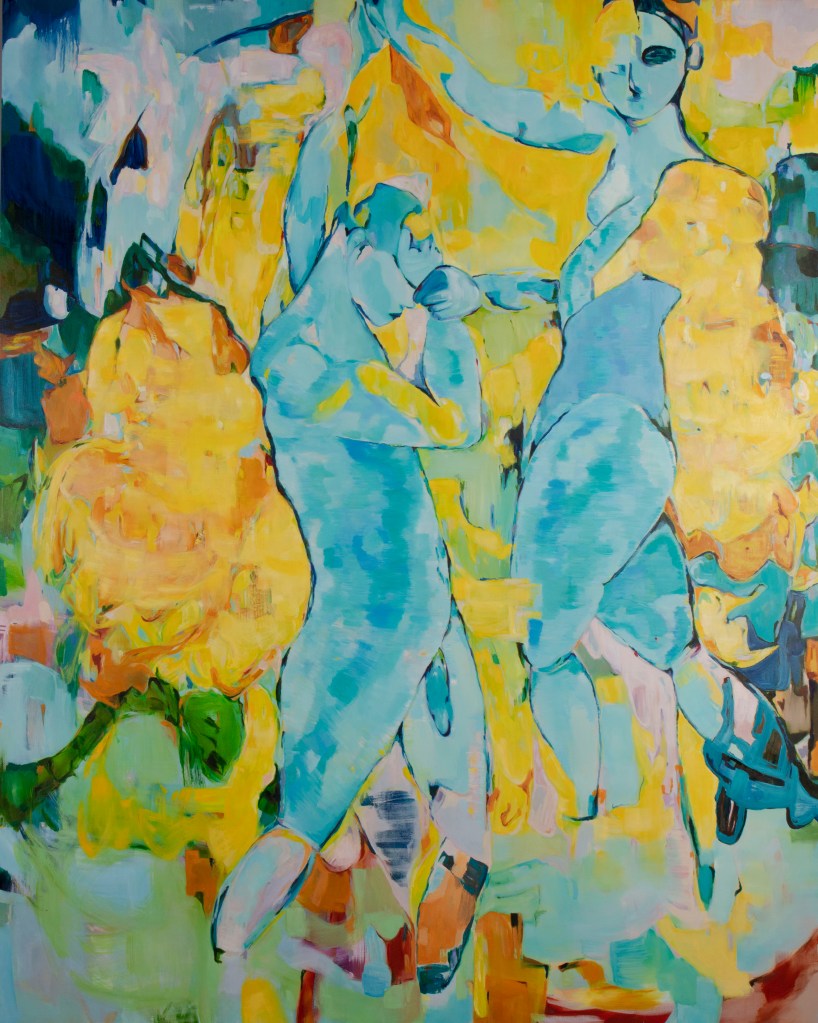
A bonding of the wild, 2024, Oil on canvas, 160 x 200 cm
Uncertainty
Before any given painting starts its journey into visibility, there needs to be a discharge of
intuition as an inaugural event. This might manifest as a drawing, an outline of a fantasy, an
utterance even. Invariably a sense of chaos predominates within this potentially
heterogeneous step, but a raw expanse of blankness awaits this starting point. Anyway,
something is always awaiting, a semblance, an image, a figure, an outline, a gesture. With
this a mood is cast, shadow or light elected to predominate, and with this an entry point is formed. The painting becomes a doorway to a world.
Two figures are assembled as the first step into visibility which might be named as such. It is probably early in the morning, but there is a doubled over feeling of entrance, from dream state or fantasy as well as to the day. Anyway, the air is thick, even perfumed thick. A feeling of the half-way pervades, the half-way of form and formless predominately. There are the accumulated memories of other painting, even if partly subliminal. Take for instance Lucas Cranach’s ‘Adam and Eve’ (1526) in the Courtauld Gallery, which seemingly has only the most remote reference to the formation of the subject of this painting. There was just something related to a gesture that opens out space between different realms, rather than any stylistic feature or manner. This opening out the difference between the way a painting might work on the artist, rather than the other way around and with this a way of understanding the relationship between the image and desire is what is so striking. A case perhaps of what is remote becoming a potent immediacy because of its latency within the discharge related to the play of unconscious modes of fixation or condensation. Perhaps this detour is another way of claiming that misrecognition or even fiction can be as formative as more obvious and direct routes to a reading.
Paintings it seems lays awake, just to be seen. Not every painting is seen though, and some paintings have a long wait to be seen. Humans create history to put to sleep that which is past. They are afraid of the nightmare that it might contain. Properly speaking there is no art history. We might though be party to assembling facts and categories under the sign of knowability, but that is just a blanket for these works to sleep under. We like to keep them warm in their designated houses. All of this might appear as a detour to the inauguration of a painting which might never become awake to itself. She was interested on what was the other side of the shame that was subliminally detected in the Cranach painting. What was she doing looking at such a painting when she had ventured to examine the great modernist works of Manet, Gauguin, Cezanne, and Seurat? Was it a detour, or even an error in her orientation? As if for only a brief, passing instance, her eyes appeared as wide awake. It was this painting that had arrested her field of vision, mysterious really, because it was so outside of what interested her about painting.
On the wall of her studio there was a reproduction of a couple of paintings by Franz Marc, some de Kooning mid-career works, and some Fauvist works by Derain and Matisse. Then there was a desire in the air. This was going to be a painting about something that had eluded her. She simply referred to this as desire, but she had no other name for this. What was the force that had created a separation of human, animal, and nature was her intuition of the question propelling her into this painting.
When she had fantasised about being naked with him, it was in an opening in a forest. Birds were singing. She thought then that she would like to paint this, but the scene faded, and the image was not retained. It was looking at this painting that had served to restore it because of the edge that it presented. The desire that had opened in her was for a space of painting through which an image could find circulation. It was less an image and much more an impulse.
Having started the painting the task is now to complete it, to find a relationship to a complete image with the sense that it can stand alone as an entity. There is both anxieties related to this but also exhilaration, a case of mixing the personal with the transpersonal. There is a mixing together of elements in this pursuit, one moment dealing with the formality of painting itself, almost its law like way of progressing forward, then the sensation of absorption into the fabric of the image, having in turn to deal with all the forces that are thrown up in this process and finally the process of integrating all the contrary elements into the drama of completion. In all of this, the painting assumes the power of looking back and that it is a figuration out of which having a gaze is formed. The painting has a face in many respects even if its characteristics are non-human.
She can now stand back from all of this. The storm has worked itself out and has departed. She wonders what it is that she has gathered into the visible or what it is that is shown apart from what it is that is sayable. Within this there is scattered patches which pertain to blindness and muteness. Such passages might be figured as knots which will never be readily undone or should anyway be left to others to muse over. she realised that the body of the painting will be quickly dispensed with in terms of the difference between the seeable and the sayable. The artist is after all placed in the middle of this expecting to have the final word or jurisdiction over such matters but at the same time experiencing th sensation of impotence. She understood that she is only allowed authorship over the initial impulse but all the rest of the process is to be handed over to the law makers. Dismal she thought but a necessary concession over being in the world. The only question that was to be answered was sweetness followed by bitterness or vice versa. There always needs to be
a principal of uncertainty with such matters she concluded.
A bonding of the wild.
A painting that folds in on itself, discovering in the process, a space in which encounter can occur. The subject appears as a silent meeting of bodies, perhaps for the first time, as in an event of becoming in which two hands lock together. This locking together signifies the entry point of the work, a passage into the imaginary space, a space that is both fractured, but also floating between sky and earth. The light is of early morning, everything is pressed up close. The air is humid, sticky perhaps. So, are the two subjects in a half dream state or are they emerging from the depth of a forest? Part nature, part dream, the first stage of the wavering unconscious is being presented. The space is shallow and yet still announces a potential of fabulous depth in which a curvature of being is staged and in which desire circulates without interruption. The “wilderness area of the imagination” in which emergence and abandonment cohere as one, surfacing within “a bonding of the wild.” This is a form of saturation in which an interpenetration of energy and form occurs alongside a meeting point of both the chemical and the alchemical within a play of form and formless. The wild imagination gives rise to seed images whose passage into be named is that of the schema. Schema couples with poiesis that marks the transition between something not existing and then becoming something. This painting is inscribed by this coupling, the coupling of bodies, the coupling of form and formless, all captured in a lingering passage of time caught between oscillation and suspension. The question arises from such a space of painting, is how to exit such a space of a never-ending sense that is opened by the subject. Painting in this, is the seduction aroused within this lack of temporal completion. The idea of late style is both an acceptance and resistance to the figure of finality. When Adorno described modernity as aspiring towards the condition of a “utopian blink,” he was also aware of the melancholic underpinning of modernity as well. Thus, the notion of the ‘blink of the eye’ (augenblick), couples with the gaze of passing time. There is a desire which is now in circulation to undo the fixity of modernist temporality, both to re-occasion of its transition towards disenchantment but also to imagine a new way of figuring transience. What at first sight is like this process of refiguring modernist schemas, is nothing other than an attempt to draw new lines of becoming with that which has been passed over and through. To do this, is to announce a new energetics within the figural impulse. Such a move is within the function of intuition which divide in Kant into two distinct spheres of the outer and inner, the spatial world of material objects and the inner world of temporal organisation of the mind. Intuition contrasts with concepts and is thereby related to sensible experience. The intuition embedded with this painting is not the speculation of a future yet to come, but in an offering to rescue what has passed, with a new curvature within lines that might have been too hastily drawn. Here we become attached to the solitary figure of Walter Benjamin and his casting of the ‘dialectical image’. There are many images caught with his collection of children’s stories, but the organizing cipher of these stories, is that of an intuition gesturing towards the unmarked imagination left to freely circulate with the wildness of the exterior. The exit point of the painting is thus to be found with the elsewhere of place at the intersection of form and disfiguration. In between entry and exit, there is a refrain of whispers that echo within the fragmentary saturations.
Text_Jonathan Miles jonathan.miles@rca.ac.uk
 Jiyeon Ryu